
Introduction
Most coping does not look like coping. It looks like staying busy when emotions rise, scrolling without noticing time pass, or choosing familiarity over rest. These responses rarely announce themselves as healthy or unhealthy. They simply become part of how we move through the day. Emotional regulation often happens quietly, in repetition, and in ways we barely register. We cope in between tasks, during ordinary moments, and through habits we rarely stop to question.
These patterns are what we can call silent emotional rituals. They are the unconscious ways we regulate emotions and cope with stress without naming them as coping at all. Emotions are not managed only during crises or breakdowns. They are managed constantly, through small internal adjustments that help us stay functional, connected, and steady enough to continue.
This blog invites you to notice the emotional rituals shaping your everyday life. It explores how unconscious self soothing habits form, the subtle ways we cope with stress, and how these patterns can quietly shift from protective to limiting. Most importantly, it looks at how emotional rituals can be gently recalibrated rather than erased, allowing coping to evolve alongside emotional awareness.
What Are Silent Emotional Rituals?
Silent emotional rituals are not intentional practices like meditation or breathwork. They live inside everyday routines and ordinary moments. They show up in how we instinctively respond to discomfort without stopping to think. For example, opening a familiar app when feeling restless, staying busy when emotions start to surface, or choosing the same safe activities after a long day.
Coping often happens through routine behaviours, familiar thought loops, or sensory preferences that feel neutral rather than emotional. This might look like replaying conversations in your head while commuting, needing background noise to feel calm, or sticking to strict routines when life feels uncertain. These rituals form slowly in response to emotional needs that were never clearly named. Over time, they stop feeling like coping and start feeling like personality. They feel less like something we do and more like “this is just how I am,” even though they are learned emotional habits shaped by repetition.
Common Unconscious Habits We Use to Cope With Stress
Many unconscious habits we use to cope with stress look ordinary and even responsible. They are socially accepted ways of staying functional when emotions feel difficult to sit with. Most of the time, we do not recognise them as coping because they do not look dramatic or disruptive. They simply feel like what makes the day manageable. Let's look at some of the unconscious habits we potentially use to cope with stress-
- Staying busy or overworkingThis often appears during emotional overwhelm, uncertainty, or vulnerability. Keeping the day full leaves little room for feelings to surface. It can look like extending work hours, filling weekends with tasks, or constantly staying “productive” because slowing down might invite emotions that feel heavy or confusing.
- Over-planning and mental rehearsingCommon when there is a lack of control or clarity. Mentally running through conversations, outcomes, or to-do lists offers a sense of predictability. Even when anxiety remains, planning creates the feeling that something is being managed.
- Emotional detachment or intellectualisingUsed when emotions feel unsafe, inconvenient, or unsupported. This may show up as analysing feelings instead of feeling them, staying logical during emotional moments, or distancing oneself from emotional situations, especially in environments where emotions were discouraged or dismissed.
- Zoning out through screens or constant distractionThis often emerges during emotional fatigue or overload. Scrolling, binge-watching, or multitasking reduces internal noise for a while. The relief is temporary, but it helps the mind rest from constant emotional processing.
- Re-reading old messages or replaying memoriesCommon during loneliness, uncertainty in relationships, or unresolved attachment. Returning to familiar emotional moments provides comfort through familiarity, even if it also keeps certain feelings stuck.
These unconscious self soothing habits are not bad or wrong. They are adaptive responses that once helped regulate emotions and cope with stress. Coping exists on a spectrum. What matters is not labelling habits as healthy or unhealthy, but noticing when they no longer offer relief and begin to limit emotional flexibility.
The Psychology Behind Unconscious Self-Soothing
Unconscious self soothing habits exist because the nervous system is designed to reduce discomfort as efficiently as possible, not to help us reflect or grow. When emotions rise, the brain shifts into regulation mode, relying on familiar patterns that have previously lowered emotional intensity. This process happens before conscious awareness, which is why soothing often feels automatic rather than chosen.
What makes these habits persistent is not comfort, but predictability. The emotional system learns which responses bring emotional intensity down fastest, even if the relief is partial or short-lived. Early experiences play a quiet but powerful role here. They teach the mind which emotions are safe to feel, which need to be contained, and what behaviours help maintain emotional stability in a given environment.
Over time, these patterns become default responses. The mind repeats them not because they are effective in the present, but because they are emotionally recognisable. Familiar regulation feels safer than unfamiliar relief. This is why people often continue the same self soothing habits even when circumstances improve. The emotional system is not seeking the best solution, only the one it already knows how to use.
Replacing Unhealthy Rituals With Healthy Emotional Coping Rituals
Healthier coping does not mean removing rituals or forcing change. Emotional habits exist because they once helped us stay regulated. Replacing unhealthy rituals with healthy emotional coping rituals works best when the actions are concrete, simple, and doable in everyday moments.
- Taking a usable pause before distractionInstead of stopping yourself completely, slow the moment down. When you feel the urge to scroll, switch tasks, or distract yourself, pause for ten seconds. During that pause, name one thing silently: “I feel tense,” “I feel restless,” or “I feel overwhelmed.” After naming it once, you can choose to continue or redirect. The pause creates awareness without pressure.
- Letting emotions exist while continuing the taskYou do not need to stop functioning to feel. Pick one emotion you notice and allow it to sit in the background while you continue what you are doing. For example, notice irritation while answering emails or sadness while cooking. Do not analyse it. Simply acknowledge it with a sentence like, “This feeling can stay while I do this.”
- Using single-sense grounding instead of numbingChoose one sense and stay with it for thirty seconds. Press your feet into the floor and notice pressure. Hold something textured and focus on its feel. Listen to one continuous sound in the room. Avoid stacking distractions. One sensory anchor helps regulate without disconnecting.
- Lowering emotional intensity through the bodyWhen emotions spike, focus on physical signals. Relax your jaw, drop your shoulders, or slow your breathing slightly. You are not trying to remove the emotion. You are turning the volume down so it becomes easier to stay present with it.
- Turning repetition into pattern awarenessInstead of asking “why do I do this,” track what repeats. Once a day, note one emotional moment and what you did to cope. Over time, patterns become visible. Tools like Healo support this by noticing repeated emotional themes and responses across days, helping awareness grow without self-judgment.
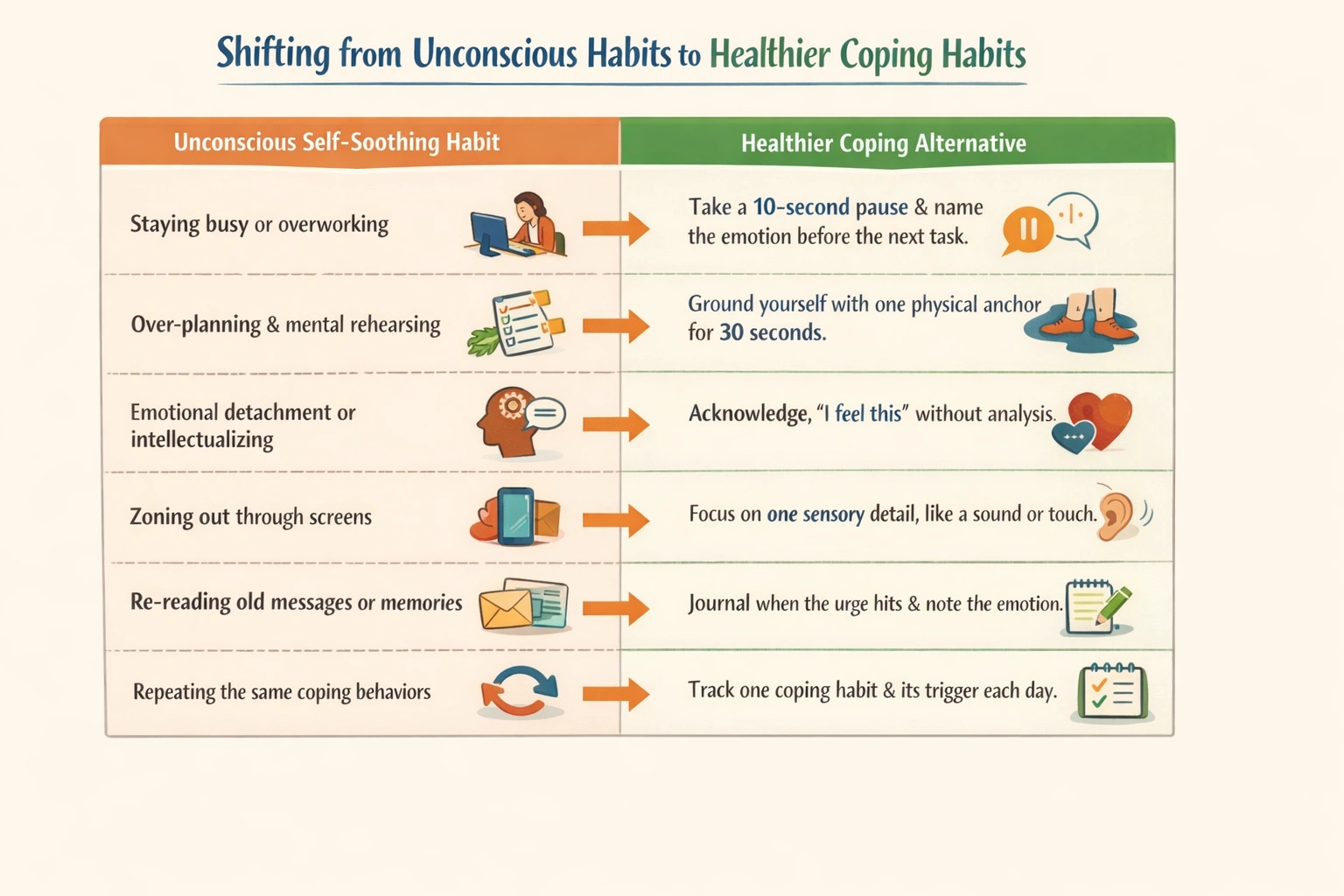
Healthy emotional coping rituals are not about perfect regulation. They are about making coping visible, flexible, and responsive to the present moment rather than driven by habit alone.
Conclusion
Emotional coping is rarely loud or dramatic. It lives in quiet rituals we repeat to stay steady. When these rituals become visible, they can be gently reshaped rather than erased, allowing coping to evolve into conscious care that supports emotional flexibility and long-term well-being.